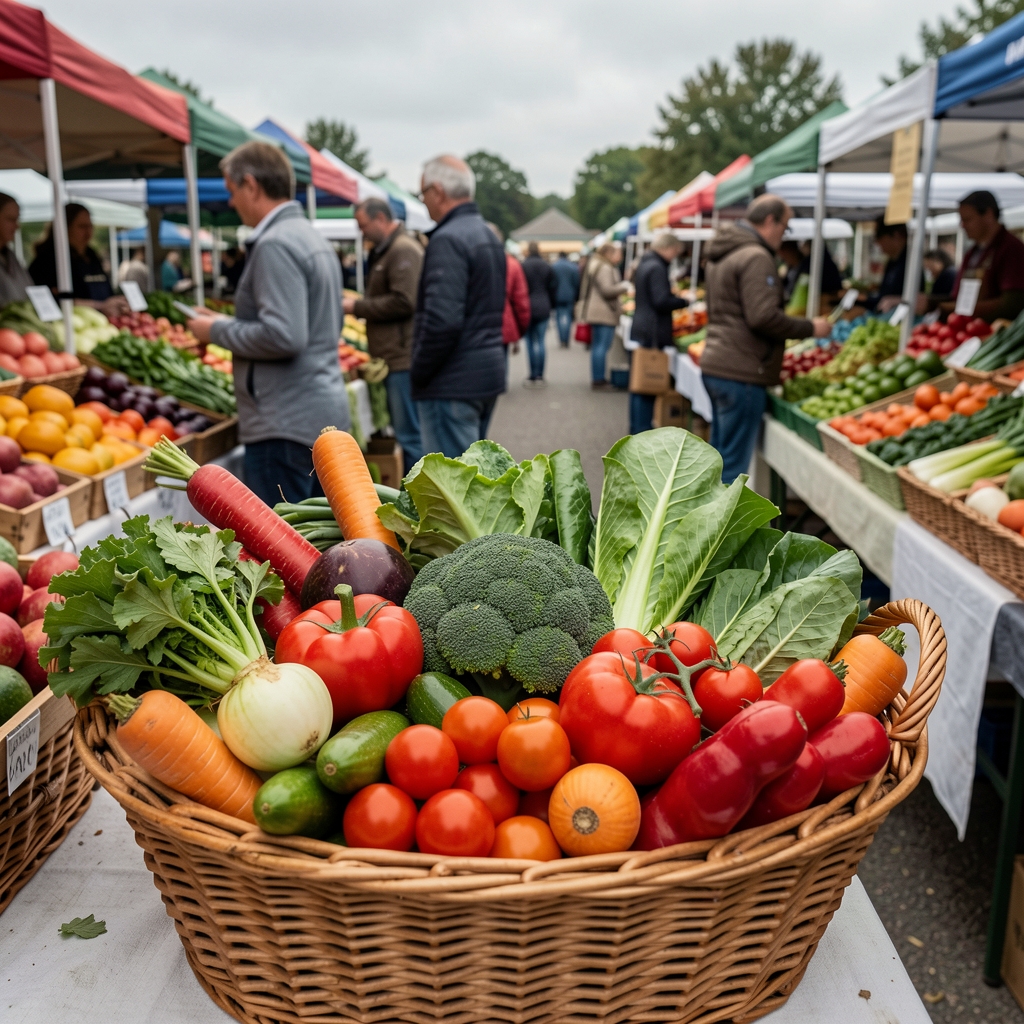
Seasonal Produce
Autumn Vegetables and the Long Arc of Weight Awareness
A nutritionist's seasonal record of how the late-year produce calendar aligns with a slower, more reflective approach to weight and eating habits.

There is a particular kind of accounting that happens when one looks back at a full week of meals rather than a single sitting. The totals, once visible, carry a quiet authority that no single exceptional choice — the salad at lunch, the skipped dessert — can wholly counteract. The week, as a unit of nutritional measurement, tells a more honest story than the day.
When people think about the relationship between what they eat and their body weight, they tend to focus on individual meals. The elaborate dinner party, the rushed sandwich at the desk, the biscuits taken with a cup of tea mid-afternoon. Each event is remembered in isolation. But nutritional awareness — the kind that actually informs lasting change — operates across a longer arc.
A week of eating contains somewhere between twenty-one and twenty-eight distinct eating events, depending on how one counts snacks. Each event is a small node in a network that, taken together, defines a person's actual nutritional intake far more accurately than any single day could. What a food journal reveals, once kept for seven consecutive days, is not so much the occasional indulgence as the underlying structure: the days when vegetables are genuinely present, the days when they are not, the meals that are hurried, the meals that are not.
From a nutritionist's standpoint, the weekly pattern is where the relevant information lives. A person who eats well on five days and poorly on two is nutritionally different from a person who eats moderately across all seven, even if the weekly caloric totals align. The distribution matters. The clustering matters. Whether the whole foods appear in the first half of the week or the second, whether the weekend involves a structural shift in portion size — these are the questions that a weekly perspective makes visible.

Food journalling — a record kept across seven consecutive days
One of the more quietly striking findings that emerges from a week of food journalling is how portion sizes shift with context. A meal eaten alone at home often differs substantially in volume from the same meal eaten at a restaurant, at a friend's house, or prepared under time pressure. The social and environmental context of eating exerts a significant influence on how much ends up on the plate — and how much is consumed.
Portion awareness, in this framing, is less about measuring food by weight or volume and more about developing a felt sense of what a typical serving looks like across different contexts. The person who eats well at home but consistently encounters much larger portions in social settings may find that the aggregate effect on their weight over several months is substantial, even though no single meal was dramatically different from what they would normally eat.
The weekly view makes this visible. When a journal entry shows that three out of seven dinners occurred in a restaurant or social setting, and that those three meals were consistently larger than the home-cooked alternatives, the pattern speaks clearly. It is not a matter of discipline or willpower in those moments — it is a matter of structural awareness about how the week is arranged.
"The week, as a unit of nutritional measurement, tells a more honest story than the day."
Whole foods — vegetables, legumes, fruit, unprocessed grains — have a particular quality when considered in the context of a weekly rhythm. They are rarely the food of convenience. They require planning: shopping earlier in the week, making time to prepare, having the energy in the evening to cook from scratch rather than reaching for something ready-made. Their presence in the weekly record, or their absence, is often less a matter of taste or preference than a matter of logistics.
This is one of the more practically useful observations a food journal can produce. When a week's record shows that whole foods were largely absent from Wednesday through Friday, it is rarely because the person stopped valuing them. It is more often because Monday and Tuesday's batch of lentils ran out, the weekend's market visit hadn't happened yet, and the mid-week had become structurally dependent on convenience options. The rhythm broke, and the plate changed accordingly.
Rebuilding that rhythm — deciding when in the week the shopping happens, which meals will always be home-cooked, which can flex — is a more durable lever for weight awareness than any single dietary rule applied to individual meals. The whole-foods approach, practised across a week rather than optimised in a single sitting, accumulates into a pattern that the body registers over time.
Gradual weight change — the kind that accumulates over months rather than weeks — is rarely the result of any single intervention. It is the residue of accumulated weekly patterns, each week's record being one data point in a longer series. The nutritionist's perspective on this is, at heart, a statistical one: no individual meal carries decisive weight, but the aggregate of many meals, arranged in a particular recurring pattern, eventually does.
What food journalling allows, when practised consistently, is the gradual development of a reader's eye for one's own patterns. Most people, asked to estimate how many portions of vegetables they eat in a typical week, will overestimate by a factor of roughly two. The journal corrects that estimate with primary evidence. The correction, once made visible, tends to be more motivating than any external instruction about what to eat or avoid.
The most practically useful frame is this: the week is the unit of habit. It contains enough variation to smooth out anomalies, enough repetition to reveal structure, and enough length to show where the reliable choices live and where the vulnerable gaps appear. Attending to the week, rather than the meal, is where nutritional self-awareness becomes most actionable.
Mindful eating — paying deliberate attention to the experience of a meal rather than consuming it on autopilot — is often discussed as a moment-by-moment practice. The breath before eating, the slower pace, the attention to flavour and texture. These are genuine observations about how attention affects both enjoyment and intake. But mindful eating gains a further dimension when it is understood as a weekly rather than a meal-level practice.
At the weekly scale, mindfulness might mean reviewing Sunday's food journal entries on a Monday morning, noticing where the week diverged from what was intended, and identifying one or two structural adjustments for the week ahead. Not a resolution or a dramatic change, but a quiet recalibration of rhythm — ensuring that the logistical infrastructure for good eating is in place, that the vegetables are bought, that a meal is planned for the mid-week evening when energy tends to be lowest.
This kind of reflective practice — record, notice, adjust — is, in the view of the writers here at Talevo Field Notes, the most enduring form of nutritional awareness. It does not require dietary perfection. It requires only honesty about what the week actually contained, and a mild curiosity about what a slightly different arrangement might produce.

Eleanor Whitfield is the lead editor at Talevo Field Notes, with a background in nutritional science and ten years of writing on food, weight awareness, and daily eating habits.
More from Eleanor →
A nutritionist's seasonal record of how the late-year produce calendar aligns with a slower, more reflective approach to weight and eating habits.

How daily movement patterns intersect with food choices, portion sizes, and the gradual arithmetic of weight balance over weeks and months.